
Cyber threats evolve continuously, and organisations need a way to validate their defences beyond periodic security assessments. Red Teaming as a Service (RTaaS) provides ongoing adversary simulations that test detection, response, and overall security effectiveness against real-world attack scenarios. In this article, you will learn how Eventus Security, a CERT-In empanelled red teaming provider, delivers RTaaS, how it differs from traditional red teaming and penetration testing, and how continuous validation helps strengthen cyber resilience over time.
Table of Contents
Key Takeaways
- Red Teaming as a Service (RTaaS) provides continuous security validation rather than a one-time assessment: Recurring attack simulations help organisations identify new attack paths, validate security controls, and strengthen cyber resilience as threats and environments evolve.
- RTaaS measures how well an organisation can withstand a real-world attack, not just whether vulnerabilities exist: By simulating realistic adversary behaviour, it tests detection capabilities, incident response processes, and overall defensive effectiveness.
- Modern RTaaS programmes evaluate people, processes, and technology together: This broader approach uncovers security gaps that traditional vulnerability assessments, compliance audits, and standalone penetration tests may not identify.
- AI and LLM systems have become an important part of red teaming programmes: Continuous testing helps organisations identify prompt injection risks, guardrail bypasses, data exposure issues, and other emerging AI-specific threats.
- Eventus Security combines RTaaS with 24/7 SOC operations to deliver measurable security improvements: Red team findings are continuously fed into detection engineering, incident response workflows, remediation efforts, and security training programmes.
What is Red Teaming as a Service?
Red Teaming as a Service (RTaaS) is a managed offensive security service that continuously simulates real-world cyber attacks to evaluate how effectively an organisation can detect, respond to, and contain threats. Unlike a one-time penetration test or periodic security assessment, RTaaS provides ongoing validation of security controls through recurring human-led adversary emulation and automated testing.
By assessing people, processes, and technology together, RTaaS functions as an ongoing security posture assessment that uncovers security gaps, tests defensive readiness, and helps organisations continuously strengthen their security posture against evolving attack techniques and threat actors.
What Does an RTaaS Engagement Include?
An RTaaS engagement includes recurring attack simulations, defined testing scopes, and structured reporting designed to continuously validate an organisation’s security controls. Unlike a single assessment, it combines multiple testing activities and retesting cycles within an ongoing program.
What Attack Types Does RTaaS Cover?
The scope typically includes external attack simulations against internet-facing assets, internal attack paths that test lateral movement and privilege escalation, and social engineering exercises such as phishing. Depending on organisational risk, engagements may also cover cloud environments, business applications, APIs, identity systems, and selected supply chain or third-party access scenarios to reflect realistic attacker behaviour.
What Do You Receive at the End of an RTaaS Engagement?
Each engagement cycle produces documented attack narratives, evidence of successful attack paths, control validation results, and prioritised remediation recommendations. Organisations also receive executive-level summaries, technical findings for security teams, and retest results that demonstrate whether identified weaknesses have been successfully addressed.
How Does Red Team Services Protect Organisations Around the Clock?
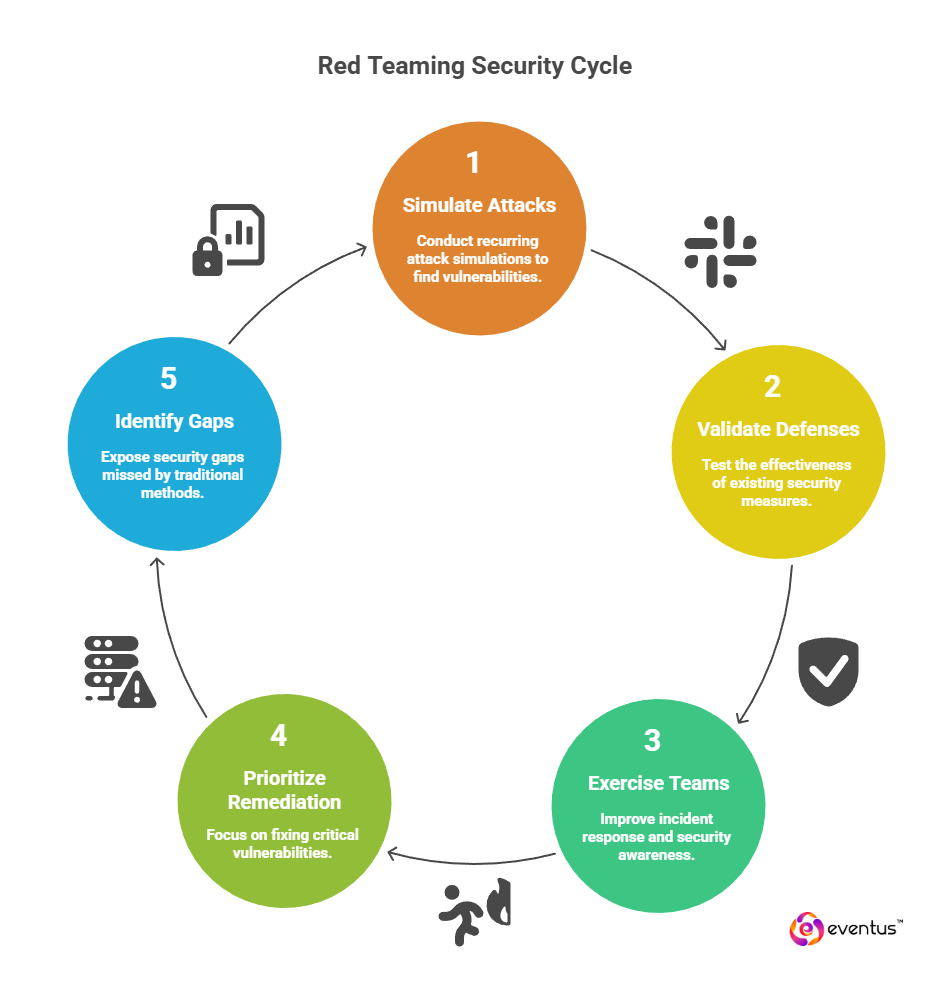
Red Teaming services protect organisations around the clock by continuously validating how effectively people, processes, and security controls detect, resist, and respond to realistic attack scenarios. Rather than relying on periodic assessments, they provide ongoing visibility into emerging weaknesses, defensive performance, and remediation effectiveness as the environment evolves. Here’s how it protects organisations around the clock by continuously stressing and improving the organisation’s overall security posture:
- Continuous attack simulation: Managed red team operations run on a recurring schedule and can use continuous automated red teaming services to probe for new exposures between major campaigns. This ensures security vulnerabilities are found closer to when they are introduced, not months later during an annual test.
- Validation of real defences, not just configurations: Red teaming focuses on how well existing security measures, security controls, and the security team actually resist real-world cyber attacks. It goes beyond scanning to test detection, blocking, and containment in live conditions.
- Exercising blue and purple teams: When aligned with the blue team or run as a purple team, managed red teaming services show how quickly defenders spot and respond to red team attempts. This directly improves incident response, tuning of security operations, and security awareness training.
- Prioritised remediation and measurable improvements: Each red team assessment produces evidence-driven findings that help security leaders evaluate the security of critical assets and prioritise fixes that most effectively strengthen organisational security posture and improve overall security.
- Coverage where traditional security goes blind: Because red teaming services simulate real-world attacker behaviour, it often exposes security gaps that traditional security testing and routine compliance-driven security services miss, such as flawed security policies, weak inter-team handoffs, or untested incident response playbooks.
Continuous testing enables organisations to move beyond periodic assessments and adopt a more proactive security validation approach. Through continuous red teaming, organisations can identify emerging attack paths, validate controls against evolving threats, and measure improvements in defensive maturity over time.
These engagements frequently include external red team assessment activities focused on internet-facing assets and internal red team assessment exercises that simulate an attacker operating within the organisation's environment. Together, they provide a comprehensive view of attack path exposure, response effectiveness, and overall organisational resilience.
Want a deeper technical breakdown?
Download the Eventus Security Red Teaming as a Service Guide to explore methodologies, sample attack paths, metrics, and remediation models used in real-world environments.
👉 Download the Red Teaming Guide (PDF)
See 24/7 Red Teaming as a Service
How is Red Teaming as a Service Different from Traditional One-Time Red Team Engagements?
RTaaS contrasts with traditional one-time red team engagements by providing continuous, recurring security validation rather than a single point-in-time assessment. Here’s how they both differ:
| Dimension | Traditional one-time red team engagement | Red Teaming as a Service (RaaS) |
| Timeframe and cadence | One-off, time-boxed project run occasionally. | Runs at an agreed recurring frequency of red team exercises, making red teaming services an ongoing process, not an event. |
| Security insight and coverage | Provides a point-in-time view of security risks and security issues. | Evaluates the environment repeatedly, helping track whether fixes still work against sophisticated cyber threats. |
| Integration with security strategy | Often sits outside routine security operations and is isolated from day-to-day information security workflows. | Each cycle’s results are used to refine the organisation’s security measures and broader security strategies. |
| Relationship with penetration testing | Red teaming services and penetration testing are tightly scoped and stop once impact is proven. | Red teaming services and penetration activities are repeated and combined to deliver comprehensive security over time. |
| Red–blue collaboration and evolution | Limits collaboration between red and blue teams to a post-exercise debrief. | Builds ongoing collaboration where red team members continuously feed gaps and improvements into SOC and IR teams. |
| Accessibility and long-term value | Requires fresh budget and planning for every engagement, so testing is sporadic. | Managed model makes red teaming more accessible and delivers recurring benefits, steadily strengthening overall posture. |
How Is RTaaS Different From Penetration Testing?
Penetration testing focuses on finding and validating technical vulnerabilities within a fixed scope and short testing window, usually for compliance or release readiness. RTaaS goes beyond this by simulating how real attackers chain multiple weaknesses across systems and testing whether your organisation can actually detect, respond, and contain those actions in real time through continuous or recurring exercises.
| Dimension | Penetration Testing | RTaaS |
| Goal | Identify vulnerabilities | Validate real attack paths |
| Scope | Fixed and system-specific | Adaptive across environment |
| Method | Scripted and tool-driven | Stealth, multi-stage emulation |
| Output | Vulnerability report | Attack narratives + detection gaps |
| Focus | What is broken | How far can attackers go |
When Should You Use Red Teaming vs Penetration Testing?
In practice, neither is a replacement but a sequential layer in security validation. Penetration testing is best used to fix known weaknesses in a defined system or release cycle, while RTaaS is used when the priority shifts to understanding real-world exposure, attacker movement, and the effectiveness of SOC detection and response across the environment.
How Does AI and LLM Red Teaming Fit Into Modern RTaaS?
As organisations adopt AI applications and large language models (LLMs), red teaming must extend beyond traditional networks and endpoints. AI red teaming evaluates whether models can be manipulated, bypassed, exposed to sensitive data leakage, or made to generate unsafe outputs. Within an RTaaS programme, AI and LLM red teaming provides ongoing validation of AI security controls as models, prompts, integrations, and threats continue to evolve.
How Is AI Red Teaming Different From Traditional Red Teaming?
Traditional red teaming focuses on compromising systems, networks, identities, and security controls. AI red teaming focuses on testing model behaviour, prompt injection risks, guardrail bypasses, data exposure, hallucinations, and other AI-specific attack paths. The goal is not only to gain access but also to determine whether AI systems can be manipulated in ways that create business, security, or compliance risks.
Why Do AI Systems Need Continuous Red Teaming?
AI threats evolve as quickly as the models themselves. New prompt injection techniques, jailbreak methods, integrations, and model updates can introduce risks that did not previously exist. Continuous AI red teaming helps organisations identify emerging weaknesses, validate safeguards, and ensure AI systems remain secure, reliable, and aligned with intended business use cases over time.
How Does Eventus Security Deliver Red Teaming as a Service in Real-World Environments?
Eventus Security delivers Red Teaming as a Service by conducting recurring, intelligence-led attack simulations against real production environments and business-critical assets. Rather than treating red teaming as a one-time exercise, Eventus runs continuous campaigns that emulate realistic attacker behaviour, including phishing, lateral movement, privilege escalation, and application abuse. This approach helps organisations understand how far an attacker could progress within the environment and whether existing security controls can effectively detect and stop malicious activity.
Each engagement is designed to produce actionable outcomes rather than theoretical findings. Eventus Security identifies detection gaps, control weaknesses, and process failures, then feeds those insights into remediation, retesting, and Security Operations Centre (SOC) improvements. By continuously adapting scenarios to evolving threats and changes in the environment, Eventus helps organisations strengthen detection capabilities, improve incident response effectiveness, and continuously enhance overall security operations.
How Does Eventus Security Adapt Red Team Scenarios to Different Industries and Regulatory Environments?
Eventus Security adapts red team scenarios by tying every engagement to the industry’s core processes, crown-jewel assets, and regulatory controls, so each campaign behaves like the threats that target that sector.
Here’s how:
- Industry- and regulation-specific scoping: For banks and fintech, scenarios focus on payment rails, customer data, and fraud paths; for healthcare, on PHI and clinical systems; for industrial and OT, on production continuity and safety. This alignment is what makes a successful red team exercise relevant to auditors, regulators, and boards.
- Testing mandated controls in practice: Eventus Security designs paths that deliberately hit controls required by PCI-DSS, HIPAA, GDPR, ISO 27001, or NIST CSF, so red teaming services can help prove whether access control, logging, segregation of duties, and incident handling work in real conditions, not just in policy.
- Tuning intensity and cadence by sector: The red team exercises depend on operational risk tolerance: some industries get narrow and deep chains that avoid disrupting critical services, others support broader internet-facing tests. This is where red teaming vs generic, checklist-style audits becomes clear.
- Continuous evolution of scenarios: As cloud, open banking, telehealth, or industrial IoT change each sector’s risk profile, Eventus Security refreshes tools and playbooks to reflect the evolution of red teaming and attacker tradecraft to strengthen 24/7 SOC services. In practice, teaming is often an iterative loop, where the red team also updates scenarios every cycle to stay aligned with live threats and current regulations.
Need help with managed red teaming?
How Does Eventus Security SOC Work Together with Red Teaming to Provide Always-on Protection?
At Eventus Security, red teaming and SOC operations work together to continuously identify detection gaps, validate response processes, and improve defensive effectiveness against real-world attacks. Here’s how Eventus Security SOC work together with red teaming services to provide always-on protection, including for organisations evaluating the best SOC provider companies in India:
- Eventus Security red team campaigns feed the SOC: After every red team exercise, Eventus analysts convert missed or weak alerts into new SIEM rules, SOAR playbooks, and enrichment logic, so detections reflect real red team attack chains, not just generic threat intel
- The SOC uses red teaming to test its own performance: During simulations, Eventus SOC tracks MTTD (mean time to detect) and MTTR (mean time to respond) for each scenario, then closes specific gaps in alerting, triage, and escalation before similar attacks appear in production.
- Red and blue teams collaborate in structured purple-team reviews: Post-exercise debriefs between red team operators and SOC analysts align telemetry, detections, and response workflows, turning every campaign into concrete defensive changes rather than just a report.
- Red-team patterns are turned into 24/7 monitoring logic: Behaviours observed in simulations, such as lateral movement paths, credential abuse, and cloud misuse patterns, are encoded into continuous SOC detections, allowing Eventus to provide always-on protection even when no live exercise is running.
In Which Scenarios Should Organisations Use Red Teaming as a Service from Eventus Security?
Organisations should use Red Team as a Service from Eventus Security when they need to prove how their defences hold up against real attackers, not just tools and checklists. Given below are the scenarios:
- Before high-impact launches: For a new banking app, SaaS platform, or public portal, Eventus runs red team campaigns to test the internet-facing attack surface and data flows before go-live
- After major architecture changes: Following cloud migrations, zero trust rollouts, or identity/network redesigns, Eventus simulates lateral movement, privilege escalation, and data theft to validate the new security architecture.
- To verify SOC, SIEM, MDR/XDR performance: When a detection and response stack is new or heavily changed, Eventus red teaming services measure what is detected, how fast (MTTD), and how well incidents are handled (MTTR).
- When regulators, customers, or the board want proof, not promises: In regulated or high-target sectors (banks, fintech, healthcare, government, OT/ICS), Eventus provides campaign-style simulations mapped to real threat actors and TTPs, creating evidence that controls work, and reinforcing response readiness through AI-driven SOC as a service workflows that operationalise the findings.
- When internal red team capacity is limited: If in-house teams lack scale or specialised skills (cloud, identity, OT), Eventus delivers full end-to-end red team campaigns as a managed service, turning them into a repeatable engine for measurable resilience improvements.
How Can Boards and Regulators Use Red Teaming Outcomes as Assurance of Cyber Resilience?
Boards and regulators can use red teaming outcomes as concrete proof of cyber resilience when they treat them as measurable assurance, not just technical reports. Here’s how:
- Validate critical business processes, not just systems: When red team reports show how attacks move through payments, trading, claims, or clinical workflows, boards and regulators can see whether business-critical services remain available and trusted under real attack conditions
- Map findings to control frameworks and obligations: Outcomes should be linked to specific NIST CSF, ISO 27001, PCI-DSS, DORA, RBI, GDPR or similar controls. This lets oversight bodies check whether stated policies and regulatory requirements actually hold up when tested by realistic adversary simulations.
- Cross-check management assurance with red team evidence: If controls reported as “effective” in RCSA or internal audits are repeatedly bypassed in red team scenarios, that gap signals governance and assurance weaknesses, not just technical issues. Outcomes become a reality check on self-attestation and can be continuously validated with support from soc as a service providers.
- Insist on retesting to verify that lessons are implemented: True assurance comes when previously exploited attack paths are retested and shown to be blocked. Boards and regulators should expect explicit proof that findings are remediated and no longer exploitable in subsequent red team exercises.
What Methodology Does Eventus Follow for Planning, Executing, and Remediating Red Team Exercises?
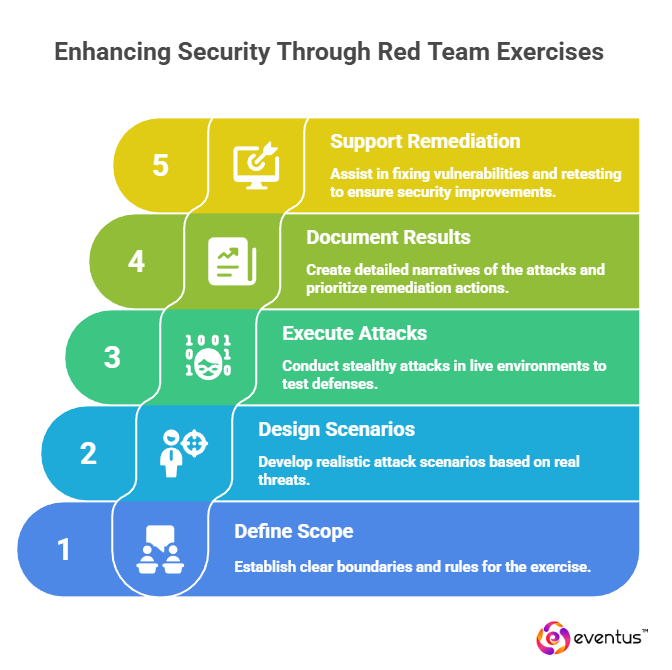
Eventus Security follows a structured red teaming methodology that combines threat-informed planning, realistic attack execution, and continuous remediation. Each exercise is designed to emulate real-world adversaries, validate security controls, identify detection gaps, and ensure that findings translate into measurable improvements across security operations and incident response processes.
Given below are the methodologies:
- Defines scope and rules of engagement around business-critical systems and risk tolerance
- Design threat-informed scenarios aligned to real attackers and industry context
- Executes stealthy, multi-stage attacks in live environments to test controls and response
- Documents results as attack narratives with prioritised remediation actions
- Supports remediation and retesting to confirm fixes and track measurable security improvement
Is RTaaS Cost-Effective Compared to Building an In-House Red Team?
For most organisations, enterprise red teaming through RTaaS is significantly more cost-effective than building and maintaining an in-house red team. Establishing an internal red team requires specialised talent, continuous training, attack infrastructure, security tools, and dedicated resources to stay current with evolving adversary techniques.
RTaaS provides access to experienced offensive security professionals, proven methodologies, and ongoing testing without the overhead of recruiting and retaining a full-time team. This allows organisations to validate their security posture regularly while maintaining predictable costs and broader testing coverage.
How do Pricing Models, Engagement Duration, and Global Support Affect Provider Selection?
Pricing models, engagement duration, and global support influence which red teaming company you choose because they determine how frequently testing occurs, how thoroughly attack scenarios can be executed, and whether the provider can support continuous security validation across different regions and time zones.
Here’s how they play a big role:
- Pricing models decide testing frequency: If a provider only offers per-engagement pricing, you’ll likely run rare, ad hoc tests. Subscription or hybrid pricing makes regular red team exercises and retests financially realistic.
- Engagement duration governs attack depth: Very short engagements usually cover narrow technical checks. Longer or programmatic engagements allow full kill chains, proper analysis, and remediation + retest, which is crucial for complex environments and for validating whether your best SOC as a service program can detect and contain realistic attack paths end to end.
- Global support affects realism and safety: A provider with only single-time-zone support cannot realistically simulate 24/7 attackers or quickly adjust rules of engagement during issues. Follow-the-sun global support is better for always-on, multi-region organisations
- Fit to your operating model is critical: The right provider is the one whose pricing, duration options, and support coverage align with your budget cycles, risk appetite, and geographic footprint.
How Can Organisations Use Recurring Red Team Results to Drive Security Culture and Training?
Organisations can use recurring red team results to improve security culture and training by converting real attack findings into practical learning opportunities. Rather than relying on generic awareness programs, teams can use actual red team outcomes to build targeted training, reinforce secure behaviours, and continuously improve employee readiness against evolving threats.
Here’s how:
- Turn real attacks into simple stories: After each red team campaign, create short, anonymised attack narratives (for example, “one phishing email → domain admin”) and share them in town halls or internal posts to make security culture concrete, especially when those insights are packaged into ongoing improvements by a managed SOC service provider.
- Build role-based training from real failures: Use recurring red team results to design targeted training: staff get phishing and data-handling lessons, developers get secure coding and config examples, SOC/IT get detection and escalation scenarios,all based on actual weaknesses, not generic slides.
- Use metrics to show cultural progress: Track and share internal trends like fewer successful phishing clicks, faster reporting of suspicious activity, and reduced dwell time from one red team cycle to the next, so people see that their behaviour changes outcomes.
- Turn findings into drills and simulations: Convert common attack paths into tabletop exercises, phishing simulations, and IR run-throughs so teams practise the exact patterns the red team used successfully.
- Recognise good security behaviour publicly: When a red team attempt is stopped early (quick reporting, correct handling, good escalation), highlight that in internal comms. This reinforces that every employee’s actions matter and embeds security into the day-to-day culture.
FAQs
1. Is Red Teaming as a Service only Suitable for Large Enterprises?
No. Red Teaming as a Service can be scoped for mid-sized organisations with critical cloud apps, payment systems, or PII. Eventus adjusts scope, cadence, and depth to match your risk profile and budget.
2. Which Internal Teams Must be Involved for a Successful RaaS Engagement?
You typically need security leadership, IT/ops, and SOC/MDR for scoping, access, and response review. Involving app owners, DevOps, and IAM teams ensures fixes reach the right systems quickly.
3. Will a Managed Red Team Program Disrupt Production Systems?
Properly governed engagements use rules of engagement, no-go zones, and attack windows to limit disruption. Eventus selects low-impact techniques that prove risk without corrupting data or affecting availability.
4. How are third-party and SaaS Platforms Treated in Eventus RaaS Engagements?
Eventus focuses on how attackers would pivot through your side of integrations, SSO, APIs, vendor access,without breaching third-party contracts. Direct testing of a provider only occurs with explicit written permission.
5. How often should you run RTaaS exercises?
RTaaS should be conducted continuously or at regular intervals throughout the year. The ideal frequency depends on your threat landscape, security maturity, compliance obligations, and the pace of infrastructure, application, or business changes.
6. Is RTaaS suitable for small and medium-sized businesses?
Yes. RTaaS helps SMBs validate their security controls without the cost of building an internal red team. It provides access to specialised expertise and realistic attack simulations that may otherwise be difficult to maintain in-house.
7. How does RTaaS support compliance requirements?
RTaaS helps organisations demonstrate ongoing security testing, control validation, and incident response readiness. While not a direct compliance requirement in every framework, it supports security objectives across standards such as PCI DSS, ISO 27001, and NIST.
8. How is RTaaS different from breach and attack simulation (BAS)?
BAS uses automated tools to simulate predefined attack techniques and validate security controls. RTaaS involves human-led adversary emulation that adapts tactics in real time, providing a more realistic assessment of organisational resilience and detection capabilities.