
Cybersecurity in 2026 will not wait for slow decisions. This article maps the top cybersecurity trends shaping the year, including AI-driven change, identity as the main battleground, ransomware and extortion tactics, cloud and data security risk, insider-driven breaches, and how compliance and cyber insurance will steer security priorities.
Table of Contents
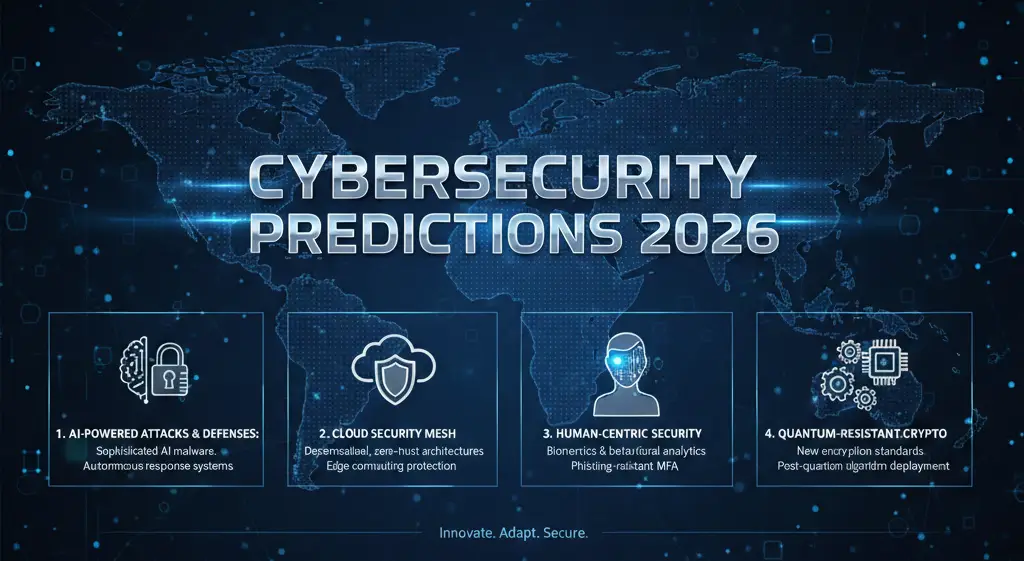
What are the top cybersecurity trends in 2026?
Across major 2026 cybersecurity predictions and threat-intelligence forecasts, the top cybersecurity trends in 2026 cluster into the following themes.
- AI becomes the default force-multiplier for both attackers and defenders: threat actors use artificial intelligence to scale speed and scope, including agentic automation across the attack lifecycle, prompt injection against enterprise AI systems, and AI-enabled social engineering; in response, security teams lean on AI-driven automation and “agentic SOC” workflows delivered by SOC managed service providers that run continuous detection and response operations to triage alerts faster and contain intrusions earlier.
- Identity becomes the primary control plane: credential abuse expands from human users to machine and AI agent identities, pushing “continuous identity” and tighter identity governance as core 2026 cybersecurity architecture.
- Deepfake and voice-based social engineering accelerates: attackers use AI-powered impersonation (vishing, synthetic media, and interview or hiring fraud) to bypass technical controls by targeting people and identity recovery paths.
- Ransomware plus data theft extortion remains the most disruptive cybercrime pattern: combined ransomware and exfiltration-led extortion persists, with increased targeting of third-party providers and exploitation of zero-day vulnerabilities to maximize breach impact.
- Cybercrime operations become more resilient and harder to disrupt: more activity shifts to public blockchains (on-chain cybercrime economy), improving adversary resilience against takedowns and financial disruption.
- Virtualization and underlying infrastructure become high-impact blind spots: adversaries pivot below guest operating systems into virtualization layers; one compromise can affect large portions of cloud compute and enterprise estates, which is why managed SOC services that correlate hypervisor, cloud control-plane, and workload telemetry are essential for detecting lateral movement that traditional host-only monitoring can miss.
- Geopolitical pressure intensifies nation-state operations and disruption risk: long-dwell espionage and stealthy campaigns continue, with emphasis on edge devices and zero-day exploitation tied to geopolitical objectives.
- Post-quantum readiness and cryptographic agility move from theory to timelines: organizations face “quantum” migration pressure and must plan cryptography changes at scale, driven by government and critical-infrastructure roadmaps.
- Software and content trust shifts toward provenance and supply chain verification: digital provenance becomes central for proving the origin and integrity of software, data, and AI-generated content, tightening supply chain assurance expectations.
- Zero trust expands beyond perimeter assumptions into continuous verification: “perimeter” security erodes further in hybrid environments, pushing zero trust as a practical framework centered on identity, context, and least privilege.
Ready to operationalize these 2026 predictions?
How will AI change cybersecurity in 2026?
- AI will automate more of the cyber kill chain in 2026, turning tasks like target discovery, lure writing, and initial access attempts into repeatable, high-volume workflows rather than handcrafted campaigns.
- Attacks will become more adaptive, because AI systems can rapidly test variations of phishing, impersonation, and evasion until one path works, shrinking defender reaction time across the threat landscape; this is why best SOC as a service that provides round-the-clock monitoring and rapid incident response matters, because it reduces detection lag when adversaries iterate faster than internal teams can investigate.
- Identity will absorb the blast radius of AI adoption, because organizations will grant autonomous access to AI agents; this shifts breach risk toward identity governance and continuous access decisions rather than static logins.
- Deepfakes and AI-enabled impersonation will scale social engineering, making voice and video less reliable proof of identity and increasing successful account recovery abuse and executive impersonation.
- Defenders will embed AI into security operations to keep up, using AI to automate correlation, triage, and response steps so analysts focus on high-impact investigations rather than alert volume.
- AI governance becomes a security control, not a policy document, because “shadow AI” and unmanaged AI usage increases exposure when AI tools are embedded into business workflows without inventory, guardrails, and monitoring.
- Cybersecurity predictions for 2026 increasingly assume AI as baseline, meaning security outcomes depend on how well teams integrate AI safely, measure it, and constrain it, not on simply “adding AI” to existing tooling.
- Compared with 2025 pilots, 2026 deployments are more operational, because AI features move into production workflows; that raises the cost of mistakes when controls are not embedded early.
Why will identity become the primary security battleground in 2026?
Identity will become the primary security battleground in 2026 because it is the fastest, most scalable intrusion path in an AI-driven cybersecurity landscape, and it sits in front of sensitive data across SaaS, cloud compute, and service providers.
- AI adoption expands access: more autonomous workflows increase identity-based cyber risk with minimal human oversight
- Machine identities explode: API keys, service accounts, and SaaS integrations create privilege sprawl and single points of failure
- Credentials bypass traditional security: valid logins often beat perimeter and endpoint controls, making intrusion easier, which is why managed SOC providers that continuously monitor identity signals and correlate login anomalies are critical for detecting credential-based intrusion before it reaches sensitive systems
- AI scales social engineering attacks: impersonation improves, boosting credential theft and account takeovers
- Identity recovery is a breach path: help desk and reset workflows are exploited to regain access
- Service providers and supply chain attacks hinge on access: vendor identities become direct entry points, raising security incidents and sensitive data exposure
What ransomware trends and extortion tactics will dominate in 2026?
In 2026, ransomware groups will prioritize extortion efficiency over novelty, combining data theft, operational disruption, and supply chain leverage to force payment at machine speed.
The following points are related to ransomware trends and extortion tactics expected to dominate in 2026.
- Modern extortion becomes the default model: ransomware and data theft remain the top financial threat, with tactics designed to bypass multi factor authentication and keep pressure high even when encryption is contained.
- Data theft extortion grows alongside encryption extortion: “ransomware” increasingly includes theft plus extortion, not only file encryption, because public leak pressure often creates higher leverage than downtime alone.
- DDoS is re bundled as an extortion add on: ransomware as a service operators add DDoS capabilities to strengthen negotiations and sustain affiliate interest as payments decline.
- Insider recruitment becomes a mainstream pressure tactic: groups increasingly attempt to recruit corporate insiders (often via native English speakers) to accelerate intrusion and improve payout probability, which is why a managed security service provider that runs continuous monitoring and insider-risk detection helps surface abnormal access patterns and privilege misuse before they become a breach
- Gig worker exploitation adds a physical layer to extortion: when remote tooling is blocked, attackers use gig platforms to get on site access for theft or foothold creation with minimal human oversight from the victim side.
- Vendor security becomes extortion leverage: attackers target third party providers and dependencies to scale impact across customers, turning one compromise into many downstream security incidents
- Operational technology and public sector disruption remains high value: the cybersecurity landscape keeps exposing connected operational technology, while public administration and municipal entities stay attractive due to disruption sensitivity and uneven security posture
- Privacy and cybersecurity are used as negotiation pressure: some ransom notes explicitly reference regulatory consequences (for example GDPR) to increase urgency around sensitive data exposure and privacy and security impact.
- The ecosystem globalizes beyond one geography: new ransomware actors outside Russia increasingly outnumber those emerging within it, expanding the pool of operators, affiliates, and access brokers.
How will cloud and data security risks evolve in 2026?
Cloud and data security risks in 2026 will evolve toward faster compromise-to-exfiltration cycles, identity-led access abuse, and larger blast radius through SaaS and service-provider ecosystems, driven by the adoption of AI and attacker automation.
The following points are related to how cloud and data security risks will evolve in 2026.
- Faster breach-to-impact cycles: adoption of AI drives machine speed intrusion, privilege abuse, and data theft
- Identity-led cloud compromise: identity and access management becomes the main control point for cloud and SaaS access
- Bigger blast radius via service providers: managed service providers and vendors amplify exposure when one account is compromised
- Extortion shifts to data leverage: attackers prioritize sensitive data exposure and privacy and cybersecurity pressure over pure downtime
- Automation-first detection and response: security measures depend on embedded security practices that can act fast enough, which is why AI driven SOC as a service that automates alert triage and orchestrates containment actions reduces response time when attackers move at machine speed
- Rising crypto transition pressure: quantum computing increases long-term data risk, pushing stronger cryptographic planning.
Have a specific scenario or requirement?
How will compliance and cyber insurance influence security decisions in 2026?
The following points are related to how compliance and cyber insurance will influence security decisions in 2026.
- Security decisions will be driven by auditable requirements, not preferences: contractual and regulatory compliance will force security posture choices that can be verified, because noncompliance can block deals or trigger enforcement.
- Insurance underwriting will push “proof-based security”: carriers will increasingly require evidence of baseline controls and operations (not statements), shaping which security measures get funded first and how cyber resilience is measured.
- Incident readiness becomes a selection criterion: compliance and insurers will weight detection and response maturity more heavily, because response planning and operational controls correlate with fewer breach-based claims.
- Vendor security will be treated as compliance scope: more organizations will align security to third-party risk expectations, since managed service providers and other service providers expand the blast radius of security incidents.
- Privacy and cybersecurity controls will converge around sensitive data handling: privacy policy obligations increasingly translate into access, logging, and response requirements that affect tool and process choices.
- State and local governments will tie funding and planning to cybersecurity outcomes: grant-linked requirements will influence prioritization and documentation, reinforcing compliance-led security practices, and SOC services that provide measurable monitoring, alerting, and incident reporting will help agencies produce the evidence required for continued funding.
- Top cybersecurity predictions for 2026 point to the same incentive structure: 2026 will reward organizations that can demonstrate controls and governance, not just deploy tools, because both compliance and insurers evaluate measurable, repeatable security posture.
Why will insider threats dominate breach root causes in 2026?
The following points are related to why insider threats will dominate breach root causes in 2026.
- The “insider” category expands beyond malicious employees: more breaches trace back to human-driven mistakes, mis-sent data, and misuse of legitimate access, which are root causes even when no exploit is used.
- Stolen credentials make external attacks look like internal behavior: when threat actors use valid logins, the breach path is “authorized access,” so root cause analysis increasingly points to identity misuse and insider-like access patterns.
- AI adoption introduces “agentic insiders” with broad permissions: autonomous tools can act with minimal human oversight; misconfiguration, prompt manipulation, or unsafe automation can trigger security incidents that originate from internal workflows and sanctioned access.
- Third-party and supply-chain access behaves like an insider at scale: vendors and service providers often hold persistent privileged access; one compromised partner account can drive widespread intrusion, making “insider access” a common breach root cause.
- Security predictions for 2026 explicitly elevate insiders: multiple security predictions highlight insider threats, including negligence and monetized access selling, as a dominant root-cause driver in the 2026 cybersecurity threat landscape.
FAQs
- How should organizations quantify “AI security risk” in 2026?
Treat it as measurable exposure: AI system inventory coverage, privileged AI agent count, and time-to-containment for AI-related security incidents. - What KPIs best show whether identity controls are working against credential-based intrusion?
Track MFA bypass rate, abnormal session detection time, privileged access review closure time, and confirmed account-takeover dwell time. - How should a security team validate vendor security when vendors have persistent access?
Require time-bounded access, activity logging, and incident notification SLAs, then test access paths during tabletop exercises and access reviews. - What is a practical starting point for post-quantum readiness without redesigning everything?
Identify long-lived sensitive data, map cryptography dependencies, and adopt a phased migration plan that prioritizes externally exposed systems first. - How can organizations test resilience against ransomware extortion without waiting for a real event?
Run breach and extortion simulations that measure restore time, data-leak response steps, and decision timing for containment versus continuity actions.