
Incidents move fast, so your response has to move faster. This article defines MTTD and MTTR in incident response, explains how to reduce them, shows how automation and log context speed detection and resolution, covers key metrics beyond MTTD and MTTR, and how to use metrics effectively to strengthen incident response.
Table of Contents
What is MTTR in incident management?
In an incident response context, MTTR reflects a security team’s response capabilities and response time from investigation to containment, remediation, and recovery. Lower MTTR usually improves reliability and service continuity, and it is often tracked alongside MTTD (mean time to detect) because faster detection (for example, earlier alerting from a monitoring tool with real-time anomaly visibility) can reduce overall time-to-restoration, but MTTR specifically measures the “fix and restore” portion, not the “detect” portion of the timeline.
What are MTTD and MTTR in incident response?
In incident response, MTTD and MTTR are time-based metrics that measure the speed of detecting and resolving a security incident, and SOC managed services providers often use these metrics to benchmark detection coverage and response execution, helping teams identify delays and tighten investigation and remediation workflows.
- MTTD (Mean Time to Detect) measures the average time it takes to identify that an incident has occurred, from the earliest occurrence of the incident (or first indicator) to detection. It quantifies how long it takes your cybersecurity monitoring and response processes to surface and confirm a security incident.
MTTD = total detection time across incidents ÷ total number of incidents
- MTTR (Mean Time to Resolve) measures the average time to resolve an incident and restore system availability, from detection (or incident start time in your process) to full resolution. It quantifies the time it takes the security team to resolve issues, remove the root cause, and reduce downtime.
MTTR = total resolution time across incidents ÷ total number of incidents
Organizations track both because reducing MTTD and reducing MTTR directly improves operational continuity, and MTTR trends often correlate with reliability outcomes such as MTBF.
Want to see how faster triage and playbooks can reduce MTTD and MTTR in your environment?
How can you reduce MTTR and MTTD in incident response?
You reduce MTTD and MTTR in incident response by tightening the full incident response process from incident detection to incident resolution, then measuring each stage with incident response metrics so bottlenecks are visible and fixable.
Reduce MTTD (time it takes to detect a security incident)
- Implement automated incident detection for high-signal events so a real actual incident is discovered faster and noise is filtered earlier. This helps lower MTTD and supports reduce false positives
- Reduce noise at the source by tuning detection rules and suppressing known-benign patterns. This increases signal quality, so a managed security services SOC that centralizes triage and alert validation can prioritize true threats faster, ensuring that when an incident is detected, it is more likely to be an actual incident
- Instrument the environment to detect a security incident across endpoints, identity, network, cloud, and critical applications. Detection gaps increase the time it takes to detect.
- Define severity and triage criteria in incident response procedures so response teams can classify faster and avoid rework
- Measure MTTD with consistent timestamps (first indicator → incident is discovered/confirmed). This makes incident metrics comparable over time and across teams.
Reduce MTTR (mean time to resolution and repair)
- Standardize response workflows with clear response actions per incident type. This reduces decision latency after the incident is discovered and speeds up when an incident is resolved
- Use automated incident response for repeatable actions (containment, isolation, credential reset, ticket enrichment). This reduces manual steps and supports mttr reduction
- Assign ownership and escalation rules so the incident response team reaches the right resolver group without handoff loops. This improves mean time to acknowledge and optimize response times, and SOC as a Service companies that provide 24/7 monitoring and escalation coverage can enforce these workflows consistently across shifts and severity tiers
- Integrate tooling across the incident management process so evidence, context, and actions flow in one path. Fragmented tools add delay to incident resolution
- Run post-incident reviews focused on the root cause and convert outcomes into updated playbooks, detections, and automation. This prevents repeat incidents and improves incident response capabilities.
- Track reliability-adjacent outcomes such as metrics like MTBF (mean time between failures) alongside incident volume, because repeated incidents increase MTTR load even if detection improves
In summary, MTTD focuses on detection speed, while MTTR (often treated as mean time to repair, mean time to respond, or mean time to resolution depending on your definition) focuses on restoration speed. To reduce MTTD and MTTR, a managed security service provider that operates continuous monitoring and guided remediation can improve detection quality and automate and standardize the response path within an effective incident response program.
How can incident response automation reduce MTTD and MTTR?
Incident response automation reduces MTTD and MTTR in cybersecurity by removing human waiting time from repetitive steps in detection, triage, and response execution, which shortens overall detection and response times compared with traditional incident response.
- It reduces MTTD by automatically correlating signals, enriching alerts, and escalating confirmed patterns so analysts do not spend time manually assembling context. This can reduce the time between an initial indicator and a validated incident, leading to low MTTD when automation is applied to high-confidence detections
- It improves MTTR by executing pre-approved playbooks that trigger the correct response actions immediately after detection, such as containment, account controls, and ticket creation with complete evidence. This makes response consistent and supports efficient incident response, which improve MTTR even when incidents are frequent
- It clarifies MTTR vs MTTD in practice: automation accelerates both, but MTTD benefits most from automated validation and triage, while MTTR benefits most from automated execution of response steps and fast handoffs for remediation
- It strengthens the incident response strategy by enforcing a standardized workflow aligned to the incident response plan, and an AI driven SOC as a Service that applies automated triage and guided response actions can keep each incident following the same steps for evidence collection, approvals, and resolution, whether it is a minor incident or a thorough incident requiring deeper investigation
- It makes outcomes measurable because automation produces consistent event timestamps and audit trails, improving measurement of key metrics and other important incident response metrics used to track performance.
Map your incident types to measurable targets and response
What are the key incident response metrics besides MTTD and MTTR?
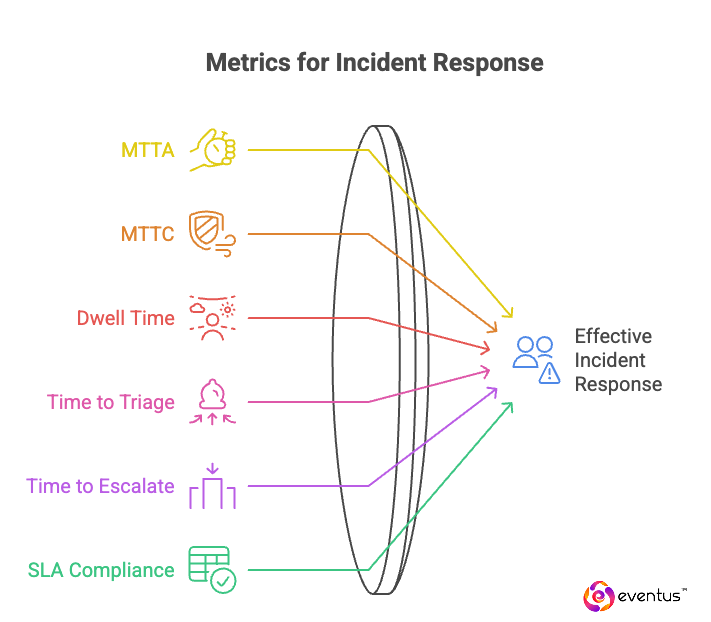
Key incident response metrics besides MTTD and MTTR include:
- MTTA (Mean Time to Acknowledge): Average time from alert creation to first human or system acknowledgment.
- MTTC (Mean Time to Contain): Average time from incident confirmation to containment that stops further impact or spread
- Dwell time: Time from initial compromise to detection or discovery (commonly used for attacker presence duration)
- Time to triage: Average time from alert receipt to classification and prioritization.
- Time to escalate: Average time to route an incident to the correct owner or resolver team
- SLA compliance: Percentage of incidents handled within defined response and resolution targets
- System availability: Uptime impact during incident periods (availability loss attributable to incidents)
- MTBF (Mean Time Between Failures): Average time between service-impacting failures or recurring incidents, used as a reliability indicator
- Mean time to failure (MTTF): Average time until a component or service fails (more common in reliability engineering, still relevant when failures drive incidents).
- Incident volume: Total incidents per period, often segmented by type and source.
- Severity distribution: Ratio of critical, high, medium, and low incidents over time
- False positive rate: Percentage of alerts or incidents closed as non-issues.
- Escalation rate: Percentage of cases requiring escalation beyond the first responder or initial queue
- First-touch resolution rate: Percentage resolved without reassignment or escalation
- Reopen rate: Percentage of incidents reopened after closure, indicating quality gaps
- Cost per incident: Direct and indirect cost per incident (labor hours, downtime, external services, impact).
These metrics form a performance view across detection quality, operational execution, and reliability outcomes, and SOC services that combine monitoring, triage, and coordinated response use this view to pinpoint delays and improve end-to-end incident handling.
How should you use incident response metrics effectively?
Use incident response metrics effectively by treating them as operational controls that drive decisions, not as vanity numbers, and managed SOC services in India that deliver continuous monitoring and escalation support can use these controls to standardize triage, reduce response variability, and sustain measurable improvements over time.
- Define each metric precisely so comparisons stay valid
- Automate timestamps so measurement is consistent
- Segment by severity, incident type, and environment
- Track the full chain, not one number
- Set targets tied to business impact
- Use dashboards to find bottlenecks and owners
- Run fix and re-measure cycles as the main way to reduce delays
- Confirm improvements strengthen security posture, not just speed.
FAQs
- What should you count as the “start” and “end” of MTTR to avoid inconsistent reporting?
Use one definition across teams, then lock the timestamps (for example, “incident confirmed” → “service restored”) so MTTR reflects the same lifecycle every time. - How do you prevent teams from gaming MTTD and MTTR numbers?
Audit timestamps, require evidence links in tickets, and review outliers byseverity so improvements reflect real response performance, not reclassification. - What is the most practical way to set MTTD and MTTR targets for different incident types?
Set targets by incident class and severity, based on business impact and response capacity, rather than one global target that hides high-risk delays. - How should you measure MTTR when resolution depends on a third party or vendor?
Track “time to mitigation” separately from “time to full resolution,” and document external dependency time so MTTR analysisremains actionable. - Which metric should you prioritize first if both MTTD and MTTR are high?
Prioritize the stage with the largest, repeatable delay (detection triage vs remediation execution), thenvalidate improvement with consistent timestamps and severity segmentation.
